Cloudflare got the web talking when it introduced EmDash on April 1, 2026. The company described it as the “spiritual successor to WordPress,” said its team had spent two months rebuilding WordPress from the ground up, and released EmDash as a v0.1.0 preview in an early developer beta. Under the hood, it runs on Astro, uses TypeScript, and pushes a sandboxed plugin model as the answer to WordPress’s long-running plugin security problem.
That got our attention immediately.
At our agency, we have spent a lot of time writing about WordPress from the perspective of businesses that are tired of carrying its maintenance load. We work with companies that want better performance, fewer emergencies, cleaner content workflows, and a platform that does not keep pulling them back into plugin updates, workarounds, and technical cleanup. So when Cloudflare launched EmDash, we looked at it seriously. We wanted to see whether this was a genuine step forward.
Some parts of it are promising.
Some parts of it feel like the web got handed WordPress again with newer framework and rebuit architecture.
That is the problem.
What we like about EmDash
We like Astro. It's our preferred web framework.
That great because Astro is one of the best foundations available today for content-driven websites. It gives developers a modern frontend framework, strong performance, flexible rendering options, and a much cleaner starting point than the old PHP theme model many WordPress projects still depend on. Cloudflare made Astro central to EmDash’s pitch, and that is the part of the product that made us pay attention first.
We also like the security direction.
Cloudflare’s launch post does not dance around the problem. It says WordPress plugin architecture is fundamentally insecure, points to plugin-driven vulnerability numbers, and explains that EmDash plugins run in isolated sandboxes with declared capabilities. In plain terms, the product aims to replace the WordPress model of “install a plugin and trust it with almost everything” with a model where access gets scoped and declared up front. That is a real improvement in concept.
That part aligns with what many businesses actually need. They do not want to wonder whether a single plugin update, abandoned add-on, or weak admin tool just opened a door into the rest of the site. They want fewer moving parts and clearer boundaries.
Cloudflare also made EmDash open source under MIT, said you can run it outside Cloudflare, and positioned it as portable across multiple storage and database options. That gives the project some credibility.
The part that we are not impressed with
Tired Old Interface
Unfortunately, interface already feels tired. We've been staring at WordPress admin screens for over 20 years, and that's pretty much why we get the tired old feeling looking at EmDash.
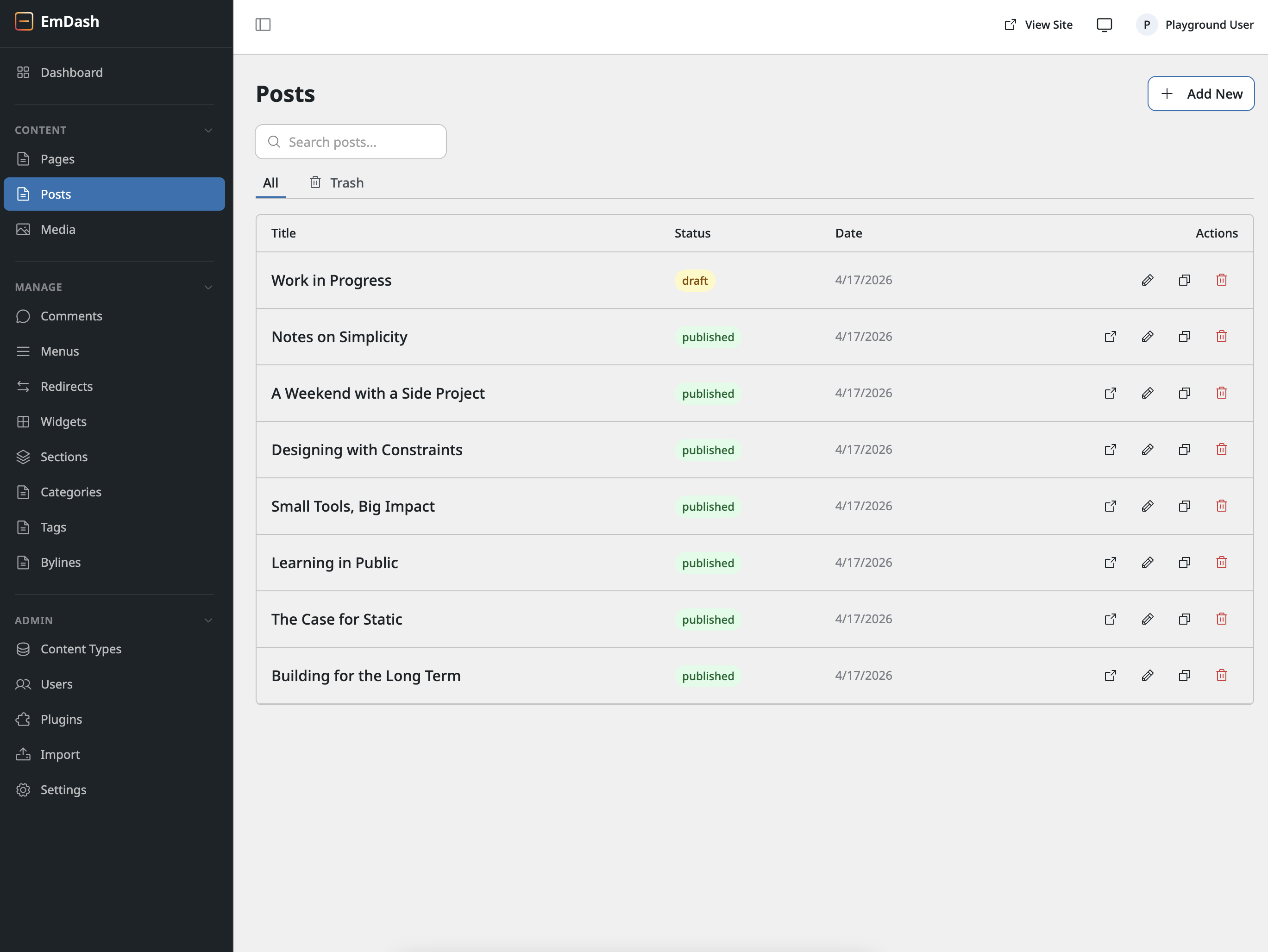
In the back of your mind your're thinking, "What kinds of glitches or problems am I going to run into today"? There's heavy psychological emotional baggage attached to that interface that is too much for the mind to bear. People that don't work in WordPress that much, will never have those kinds of insights.

Joost wrote that EmDash “looks a lot like WordPress,” and his description of the editor shows a familiar structure with title, featured image, rich text editor, categories, and publish controls. Maciek Palmowski said the admin panel has an old TinyMCE feel and compared the theming model to pre Full Site Editing WordPress. Those observations line up with what we saw too.
That familiarity might excite people who still feel nostalgic about older WordPress. It does very little for us.
Please, no more WordPress! Please no more S'mores!
We are frankly tired of looking at the same old CMS interface.

A lot of agencies that have spent years inside WordPress do not want a product that reminds them of the same old post editor, the same old admin logic, and the same old assumptions about how publishing should work. We do not look at a WordPress-like admin and think, “finally, this again.” We think, “we already know where this mental model leads.”
That is the deeper issue with EmDash right now. It does not just borrow a few ideas from WordPress. It seems eager to preserve WordPress’s default worldview.
The blogging-first mindset, again.
The EmDash README tells the story.
Its feature list leads with blog posts, pages, and custom content types. Its admin feature list includes navigation menus, taxonomies, widgets, and a WordPress import wizard. One of its three official starter templates is a classic blog with sidebar widgets, search, RSS, categories and tags, and comment-ready behavior.
That tells you exactly how the product still sees the world.
Posts matter first. Blog structure sits near the center. Widgets still get a seat at the table. Comments still show up as part of the default model for the platform. The old publishing model still has a strong grip on the interface.
That is where we lose interest.
Most companies we work with are not trying to recreate a mid-2010s blogging setup. They need marketing pages, landing pages, structured service content, reusable content sections, better governance, and a cleaner relationship between design, content, and code. They do not need sidebar widgets. They do not need their CMS to feel like it assumes everyone still runs a blog at the center of the business website.
Blogging should absolutely be available. Many organizations still need it.
But “blogging available” and a “blogging-first product” are not the same thing.
EmDash still feels too close to the second one.
Lack of Modern CMS Features
We know it's early days but the plan should be for a modern set of features, because that is what people want. If you want to be WordPress' successor, you better blaze past it with solutions to the old WordPress limits and issues.
For a CMS that wants to present itself as a serious step forward, the public feature set still feels narrow compared with mature modern platforms. The official project materials highlight content types, rich text editing, drafts, revisions, scheduled publishing, inline visual editing, a media library, menus, taxonomies, widgets, and WordPress import tools. That is a workable starting point. It does not read like a CMS that has already built a stronger authoring experience than the platforms businesses are trying to move toward.
Take live preview. EmDash does advertise inline visual editing and preview, but the preview story still looks early. There is an open bug where the admin Preview button ignores a collection’s configured URL pattern and sends editors to the wrong path. Another public migration write-up noted that draft preview was not simply ready out of the box and required extra setup with a preview secret before it worked properly. For a modern CMS, preview should feel dependable and polished. It should not feel like a feature that still needs extra care before editors can trust it.
Then there is the field system. This is where platforms like Statamic set a much higher standard. Statamic documents more than 40 core fieldtypes, including assets, entries, Bard, Grid, Replicator, video, users, terms, structures, tables, dictionaries, and relationship fields that let editors create and edit related items directly from the field itself. EmDash talks about a visual schema builder and fields, but its public materials do not show anything close to that level of built-in field depth or editorial flexibility yet. That matters because a better CMS is not just about cleaner code. It is also about giving content managers stronger core tools without making developers build every better editing experience from scratch.
The same pattern shows up elsewhere. There are signs that EmDash has content-level internationalization, but an open issue says the admin interface itself is still English-only, with hardcoded strings across the product. That is not a small detail. A modern CMS should feel ready for real organizations, real editors, and real multilingual workflows, not just modern infrastructure. EmDash may get there. Right now, it still feels more like a promising technical rebuild than a fully formed modern CMS experience.
Rebuilding WordPress is not the same as moving past WordPress
Cloudflare openly framed EmDash as rebuilding WordPress from the ground up and positioning it as WordPress’s spiritual successor. The project README says EmDash takes the ideas that made WordPress dominant, including extensibility, admin UX, and a plugin ecosystem, and rebuilds them on serverless, type-safe foundations.
That is exactly where our perspective differs.
The businesses we talk to are not usually looking for “WordPress again, rebuilt with TypeScript.” They are trying to get out of the cycle WordPress created for them. They want a site that feels cleaner to operate. They want better performance without layers of compensation. They want fewer dependencies, fewer surprises, fewer plugin decisions, fewer emergency fixes, and less admin clutter.
A modern CMS does not impress us just because it takes old WordPress concepts and rehosts them on better infrastructure.
It needs to show that it learned the right lessons from WordPress.
Right now, EmDash looks more interested in preserving WordPress-style editing than in leaving it behind.
This is where the product starts to feel like a clone
We do not mean “clone” in the strict legal or code sense. Cloudflare explicitly says no WordPress code was used. We mean it in the product sense. The structure, the admin feel, the migration path, the terminology, the template patterns, and the familiar content assumptions all signal a product that wants to be instantly legible to WordPress users.
We understand why that seems smart.
We just do not find it impressive.
At a certain point, trying to win by copying WordPress too closely starts to feel backward. WordPress already exists. It already owns that history. It already covers the blog-first, posts-and-pages, comments-and-widgets world. If a new CMS wants serious attention from agencies that are actively trying to move companies out of WordPress, it needs to do more than recreate the same product with a better runtime.
That is why EmDash currently feels less like a fresh category move and more like a very fast attempt to rebuild WordPress in public.
Cloudflare’s own announcement even says the team had recently rebuilt Next.js in one week with AI coding agents and then spent two months rebuilding WordPress from the ground up. That is an eye-catching story. It also helps explain why parts of EmDash feel more like a rapid remake than a fully formed product direction.
Early bugs
Cloudflare calls it a v0.1.0 preview in an early developer beta, and the GitHub repo calls it a beta preview. That does not make the project unserious. It does mean businesses and agencies should stop short of treating it like a production-proven CMS recommendation.
The issue tracker already shows the kind of friction you would expect from a very early product. Recent open issues include comments that cannot be disabled once enabled, a broken checkbox bug on the Comments admin page, WordPress import problems, deployment failures, admin content pagination limits, and imported posts losing original dates or publish status in some flows.
That is exactly why we are cautious.
We looked at EmDash and found parts of it nice and simple. We also cannot assume it is bug-free, workflow-complete, or ready for the demands that serious business sites place on a CMS. That is not a knock on a preview release. It is simply the reality of a preview release.
Why platforms like Statamic feel more convincing right now
Take a platform like Statamic for example. Statamic is a great replacement for WordPress, if you need a modern cms. The biggest reason why this is the case is because it's not trying to be WordPress. Statamic has its own point of view.
Statamic already has a live preview and over 40 field types baked into it's core plus modern CMS features that EmDash is missing out of the box.
It does not feel trapped in WordPress’s old admin habits. It does not feel like it needs to carry forward the same tired interface to make people comfortable. It feels more intentional as a CMS product. It feels more mature in how it presents content management as a modern experience rather than as a repaired version of a legacy one.
A better alternative does not simply remove plugin vulnerabilities or swap out the runtime. It changes the experience enough that you can feel you left the old system behind.
That is what many businesses want when they decide WordPress is no longer serving them well.
What we think of EmDash right now
We respect what Cloudflare is trying to do with EmDash.
We like the Astro foundation.
We like the security direction.
We like the fact that a major infrastructure company is willing to challenge WordPress’s plugin model directly.
We like any effort that reduces the chance that one add-on can expose an entire website.
But we are not excited by a CMS that still feels so close to WordPress in all the ways that wore people out.
We are tired of the old WordPress interface and the chills that come with it.
We do not need widgets to keep showing up as a core concept on modern business sites.
We do not need comments hanging around like they are still central to every publishing workflow.
We do not need a platform that leads with posts as though every organization still builds its web presence around blogging first.
We do not need WordPress nostalgia wrapped around Astro.
What we want is a CMS that actually moves content management forward for businesses. Cleaner content structures. Better page-building logic. Stronger editorial clarity. Less clutter. Less legacy thinking. More confidence after launch.
EmDash has some ingredients we genuinely like.
It also still feels too much like making WordPress again.
Businesses Outgrew WordPress for a Reason
That is the real takeaway.
If you are a developer who wants to experiment with a new Astro-based CMS and explore a safer plugin model, EmDash is worth watching closely. Cloudflare has the resources, credibility, and technical depth to improve it quickly.
If you are a business deciding where to place your next website, the standard should stay higher than novelty.
You should ask whether the platform gives you a cleaner future.
You should ask whether the editing experience fits the way your organization actually works.
You should ask whether the architecture reduces long-term maintenance and operational risk.
You should ask whether the CMS reflects modern website needs or simply preserves older defaults in a newer package.
That is where our agency lands today.
EmDash is interesting.
Astro is the strongest part of its story.
Cloudflare’s security thinking is the strongest part of its pitch.
The WordPress-like experience is the weakest part of its product direction.
The goal after WordPress should be progress.
Right now, EmDash still feels too much like a very smart attempt to make WordPress again. We'd love to see it evolve WAY past that into something uniquely suited for the needs of modern sites.