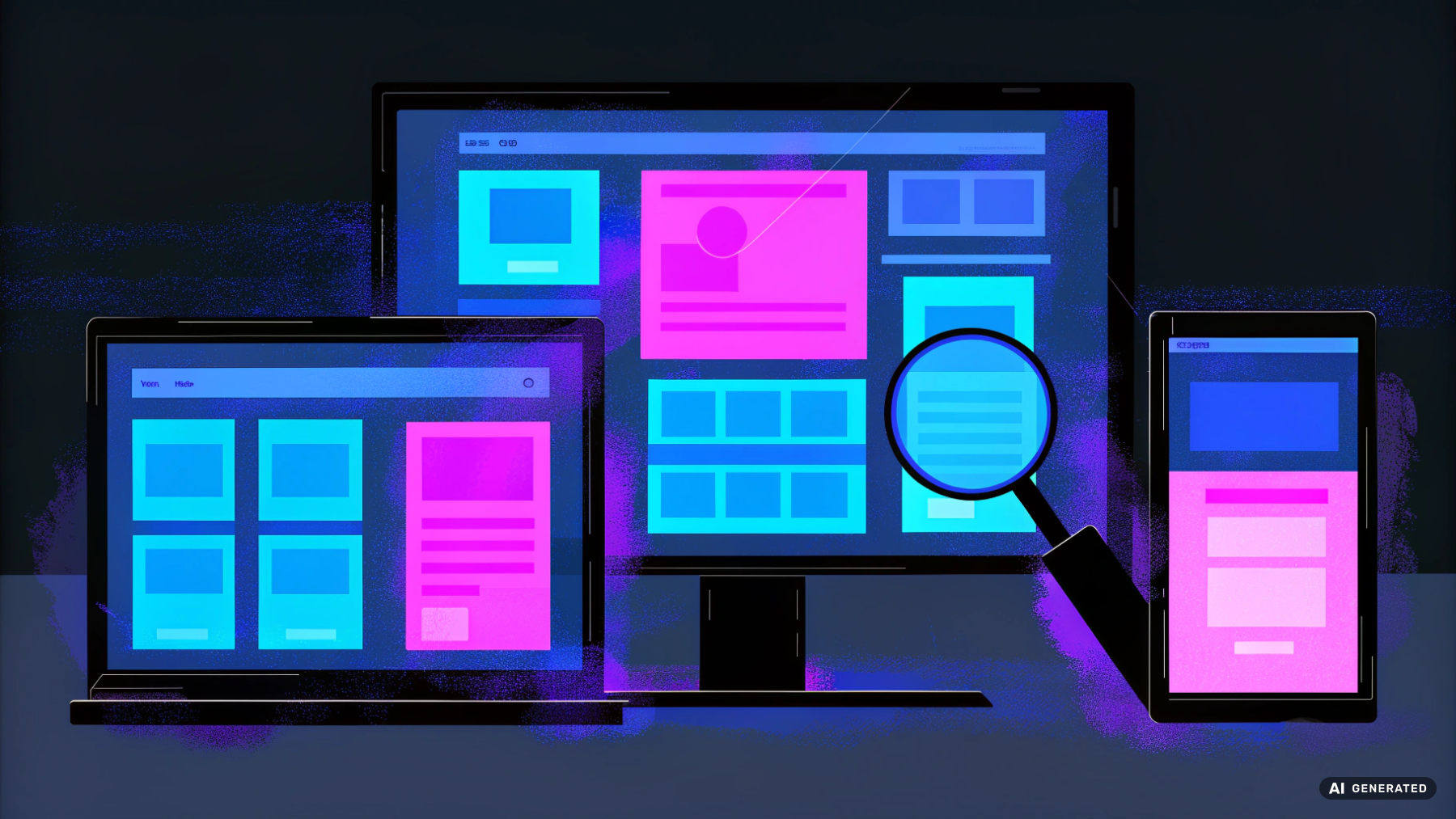
Websites are not going away or being replaced.
Every few years, since the mid-90's, the same idea circles back: websites are on their way out.
Maybe they’ll be replaced by apps. Maybe social media becomes the only channel that matters. Maybe the AI answers reduce user clicks so much that “owning a website” stops making sense. Maybe no-code tools make websites so easy to produce that they lose value.
That narrative sounds believable because the web keeps changing. But the conclusion is wrong.
Websites aren’t becoming obsolete.
And Professional Web Design is not dead, It's evolving.
Websites are becoming more important—because businesses have more competition, more channels, and less control over how they’re represented online.
A website is still the only place where a business can:
- control the message
- tell their story
- provide important information
- present proof and credibility without distractions
- create a consistent brand experience
- guide visitors toward a clear next step
Social media can help people discover you. AI can summarize you. Directories can list you. Ads can drive traffic.
But when someone needs to decide whether they trust you, your website is still where they go to understand you and verify you.
What’s changing isn’t the need for websites—it’s the standard for what a website must deliver.
The website isn’t obsolete. The “non-converting brochure website” is.
A decade ago, many sites could get by with basic pages and a contact form. Today, that approach doesn’t hold up—because buyers are more skeptical, attention is shorter, and competitors look more professional than ever.
A modern website needs to function like a business asset, not a static deliverable.
That means it should:
- support positioning (so you’re not interchangeable)
- answer real buyer questions quickly
- show proof in a way that feels credible and easy to scan
- convert consistently, not occasionally
- stay current without requiring technical heroics
The websites that struggle today aren’t obsolete because “nobody needs websites.”
Theses websites struggle because they don’t meet modern expectations.
Bad websites are becoming expensive
The cost of a bad website isn’t just aesthetics. It’s operational and strategic.
Bad websites create measurable problems:
They reduce trust at the exact moment it matters
People may find you through referrals, ads, Google, LinkedIn, or AI summaries—but they still land somewhere to judge legitimacy.
If that experience is unclear, generic, slow, or inconsistent, it doesn’t always lead to a bounce. Sometimes it leads to something worse: quiet doubt.
And doubt kills conversions.
They create friction inside your organization
If the site is hard to update, marketing slows down. If simple edits feel risky, content becomes stale. If landing pages take too long to build, campaigns get delayed.
A website that slows down marketing is not a “marketing tool.” It’s a bottleneck.
They force you into constant patchwork
When a website is built on unstable foundations, it requires ongoing fixes just to maintain baseline quality—performance tweaks, plugin updates, security patches, compatibility issues, and workarounds.
That cost doesn’t show up as a single line item. It shows up as constant drag on time and focus.
WordPress often fosters the conditions for bad websites
WordPress can be used well. But most WordPress sites in the real world don’t stay clean and disciplined over time—because the ecosystem encourages stacking tools to solve problems quickly.
Here’s what tends to happen:
- A business starts with a theme and good intentions.
- A page builder gets installed to help create pages faster.
- A form plugin gets added.
- An SEO plugin gets added.
- A caching plugin gets added.
- A security plugin gets added.
- A redirect plugin gets added.
- Then a slider, then a pop-up tool, then analytics helpers, then more.
Each tool may be “reasonable” in isolation. The issue is the compounding complexity—and how often WordPress sites become a collection of parts that weren’t designed to operate as a single cohesive system.
WordPress makes it easy to build. It also makes it easy to accumulate risk.
Over time, many WordPress sites become fragile in the most practical way:
- updates can change behavior
- plugin conflicts happen
- performance gets worse as features are layered in
- the editing experience becomes inconsistent
- the site starts requiring “special knowledge” just to manage it safely
This creates a predictable outcome: marketing departments become hesitant to touch the site, because editing feels like it might break something.
And that is one of the fastest paths to a bad website: a website that can’t be actively maintained by the business that owns it.
Builders encourage design inconsistency
Page builders promise freedom, but they often encourage “page-by-page design decisions” instead of a consistent system.
That leads to:
- pages that don’t match
- spacing and typography that varies widely
- components that get recreated slightly differently every time
- a site that feels stitched together
Visitors feel that inconsistency, even if they can’t describe it. The site starts to feel less premium, less intentional, and less trustworthy.
“More plugins” becomes a substitute for real web standards
A lot of WordPress sites end up relying on plugins to cover fundamentals that should be baked into the foundation:
- structured metadata
- performance fundamentals
- image strategy
- accessibility patterns
- clean content modeling
- scalable page templates
When those essentials are handled through layers of configuration screens, the result is often a site that works—but is harder to govern, harder to improve, and harder to keep consistent.
That’s a breeding ground for mediocrity.
AI website builders are raising expectations—and lowering quality at the same time
AI site builders have changed the market. They can produce something polished-looking fast. That’s impressive.
But they also create a new problem: a flood of websites that look acceptable and perform poorly.
AI can generate a layout and filler copy. It doesn’t automatically create:
- strong positioning
- persuasive message hierarchy
- proof strategy (what to show, where, and why)
- industry-specific buyer journeys
- conversion systems built around your actual sales process
So the result is often a website that looks modern but feels generic.
And generic is expensive.
When your site feels like it could belong to anyone, buyers compare you on the easiest metrics: price, speed, and availability.
A professional website should do the opposite—it should make the business feel like the clear choice.
The decision to “Use AI vs hiring a professional” is really “generic vs differentiated.”
There are situations where DIY tools are fine—especially early-stage projects where the goal is simply to have an online presence.
But once a website is tied to real outcomes—lead generation, growth, reputation, hiring, partnerships—the standard changes.
A professional website is built around decisions and tradeoffs that a template can’t solve:
- What do we lead with to build confidence quickly?
- What should visitors understand in the first 10 seconds?
- What objections must be addressed to reduce hesitation?
- What proof will matter most to this audience?
- What is the cleanest path from interest to action?
That’s not “more pages.” That’s strategy, design, and engineering working together.
Hiring a professional web designer is not just paying for design
A professional website is not downloading a WordPress Theme and configuring it.
A professional website is the combination of:
- strategy
- messaging
- design systems
- technical architecture
- performance standards
- SEO foundations
- accessibility patterns
- conversion structure
- maintainability
When a business hires a true professional, they’re paying for outcomes:
- the site feels credible at first glance
- it supports sales conversations instead of creating doubt
- it’s easier for marketing departments to update content confidently
- performance is strong without constant tinkering
- the structure supports growth instead of fighting it
DIY vs Professional: what changes in practice
DIY / AI site generator
- fast start
- limited depth
- generic messaging unless heavily directed
- inconsistent conversion strategy
- often becomes a rebuild later
Professional web design
- clearer positioning and message hierarchy
- intentional UX based on how buyers actually decide
- scalable page templates and content structure
- better long-term cost control because maintenance is simpler
- built to evolve, not just launch
If the website matters to revenue, credibility, hiring, partnerships, or growth, “quick” stops being the main goal.
The overlooked risk: hiring the wrong professional
There’s another trap businesses fall into:
They hire a marketing agency that “also builds websites,” and the agency refuses to use anything except WordPress—often with a heavy stack of tools that make development and maintenance harder.
This is common. It’s not always malicious. It’s often a business model decision:
- they have an existing WordPress process
- they rely on familiar themes/builders
- they want to move fast
- they want to hand off editing easily
But many businesses end up paying for a website that launches—then slowly becomes difficult to improve.
Signs you’re not getting a modern website foundation
- The site requires multiple dashboards and plugin settings to manage basics
- Editing content feels unpredictable because builder layouts behave differently per page
- Performance improvements feel like a never-ending list of technical tasks
- The site is “done,” but marketing avoids updating it because the editing experience is frustrating
- The site is highly dependent on specific tools that are hard to replace later
A website should be an asset. If it feels like a delicate machine that only certain people can touch, it’s not serving the business well.
What modern web design should look like in 2026
A modern website should be:
Fast by design
Speed is not a finishing touch. It’s a foundation that affects SEO, conversions, and perception.
Structured for clarity and growth
Content should be modeled intentionally so new pages and sections don’t turn into one-off experiments.
Easy to update without fear
Marketing should be able to edit content without breaking design patterns or requiring technical intervention for every change.
Built on a stable, maintainable architecture
The website should not depend on a growing stack of tools just to stay functional.
Why we build with Astro and Storyblok
This is where modern architecture becomes practical—not theoretical.
We often pair Astro with Storyblok because it solves the most common problems businesses face:
Astro provides a performance-focused foundation
Astro is excellent for building fast, modern marketing sites that load quickly and stay reliable.
Storyblok provides a clean, controlled editing experience
Storyblok gives content editors flexibility without turning the site into a chaotic page builder environment.
Together, they support:
- consistent components and templates
- scalable content creation
- strong performance without layers of patching
- a stable system that doesn’t require constant upkeep
This isn’t about being trendy. It’s about building websites that remain an asset for years, not a recurring rebuild cycle.
Websites aren’t going away. The bar is just higher.
The modern web is crowded, attention is limited, and trust has to be earned faster than ever. That makes your website more important—not less—because it’s still the place where people decide whether your business is credible, capable, and worth contacting.
Websites aren’t dying or becoming obsolete. What’s disappearing are the websites that don’t keep up with the business they represent. The generic sites, the neglected sites, and the patchwork sites become invisible because nobody trusts them and nobody uses them—not even the marketing department.
A modern website should reinforce your positioning, communicate clearly, and give your organization a reliable foundation for growth. If it doesn’t do that, it’s not just outdated—it’s actively working against you.